
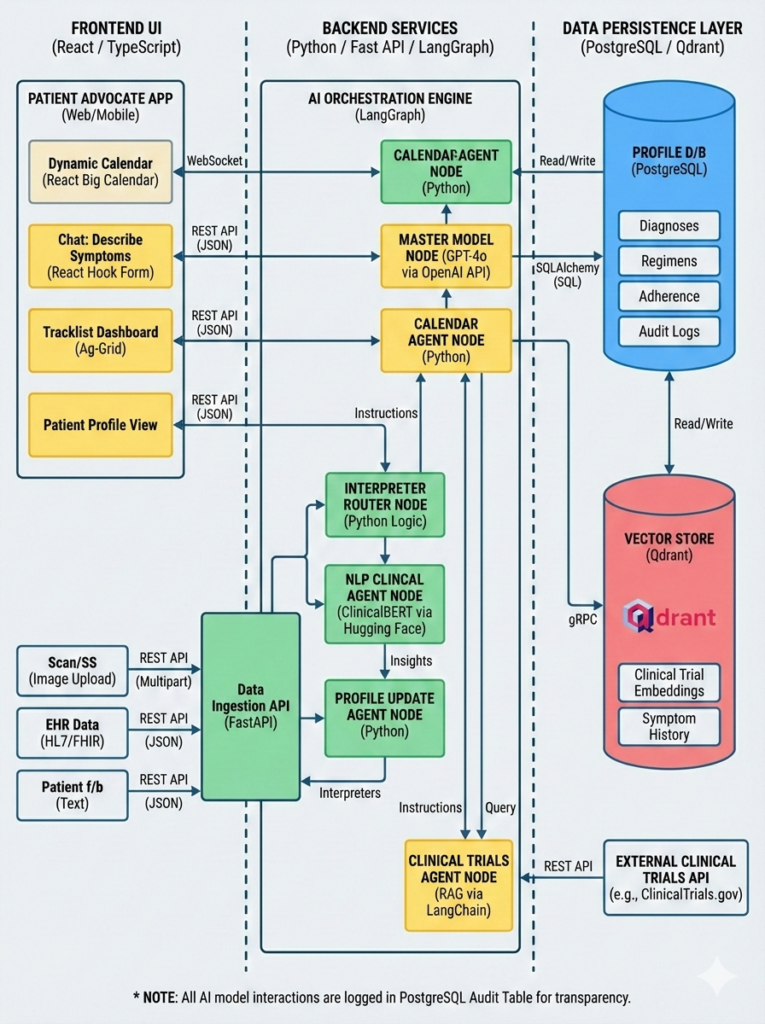
I have the architecture of the System 2 Patient Advocate: a React frontend; Python-LangGraph backend; and a data persistence layer in PostgreSQL / Qdrant. Patient feedback drives a module that can follow and analyze effectiveness of physicians’ treatments and AI models’ suggested regimens. Consider the control and vision modules on Github.
The Glass Box design tracks which model’s version generated which approach, enabling anonymized comparative analysis of their efficacies in various domains. Patient feedback can be ported to the Clinical Concierge, originally my webapp solution to the maternity care desert crisis. Subsequent to the Maternal Embodiment, I wrote the provisional patent application for the Clinical Concierge Universal Embodiment with Adel Elmagrahby, the Chair of Research and Innovation at the Speed Scientific School at University of Louisville.
The Cardiac Embodiment begs for another mechanism, system pharmacology. Advanced Therapeutics in chemotherapy involves profiling each patient and optimizing doses considering every feature throughout the network in order to sustain the heart.

Quantitative Systems Pharmacology is complex and the architecture to integrate real time drug administration and biometric input with network studies will unlock experimental and clinical potential. The cumbersome part of such software is the privacy. An encrypted tokenization will be the solution. The porting with Epic and Athena will be nothing to sneeze at. Let’s do it.
Leave a Reply